

You’ve hit a ceiling. Your 3PL is growing, but the cracks are starting to show. Orders are getting stuck in your WMS, your TMS feels like a relic from 1998, and your team is spending four hours a day manually reconciling spreadsheets just to send a simple report to a client.
In the boardroom, the conversation naturally turns to leadership. "We need a CTO," someone says. "We need a heavy hitter to come in, own the roadmap, and build us a proprietary platform that puts us on the map."
So, you go to a recruiter. They find you a candidate from a big-name tech firm or a high-growth SaaS startup. The price tag? $300,000 in base salary, plus a 20% bonus, health benefits, 401k matching, and a healthy chunk of equity. You’re looking at a $400,000 total carry to solve your tech problems.
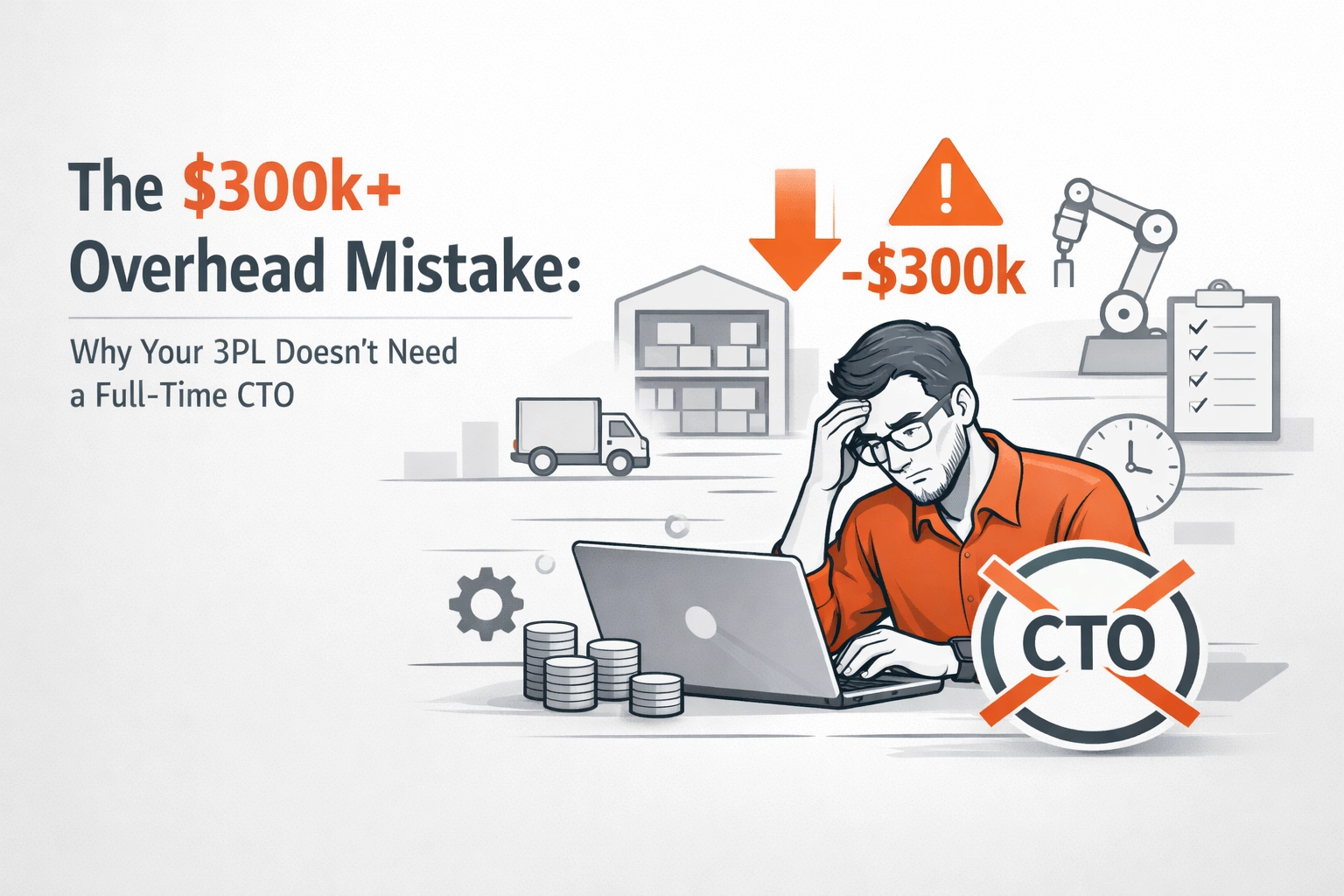
Here is the contrarian truth: Hiring that full-time CTO is likely the most expensive mistake your logistics company will make this year.
For most growing 3PLs and logistics providers, a full-time, high-priced CTO is an anchor, not a sail. You don't need a $300k executive sitting in a corner office dreaming up "disruptive" custom software. You need an "ops-first" leader who knows how to make your systems talk to each other so you can get more pallets out the door.
Why is a $300k CTO a liability for a growing 3PL?
The primary issue isn't just the salary; it’s the misalignment of skills. Most high-level CTOs are builders of products, not masters of operations. In the tech world, a CTO's job is to manage a team of developers to build software that can be sold to thousands of people. In the logistics world, your "product" is fulfillment, accuracy, and speed.
When you bring a Silicon Valley-style CTO into a warehouse environment, a few things happen:
- The Over-Engineering Trap: They want to build custom solutions from scratch because that’s what they know. Instead of optimizing your existing WMS or finding a better off-the-shelf TMS, they hire a team of three developers to build a custom customer portal that ends up being buggy and late.
- The "Cloud" Disconnect: They understand AWS and Kubernetes, but they’ve never seen a Zebra printer fail during a peak-season Tuesday. They don’t understand the visceral pain of a shipping station going down when you have 5,000 packages left to manifest.
- High Overhead, Low Output: At $300k+, that executive needs an assistant, a budget, and a middle-management layer. Before you know it, your "tech budget" has tripled, but your actual throughput hasn't moved an inch.

What happens when a "Tech Guy" doesn’t understand the warehouse floor?
Logistics is a game of inches and seconds. It is a physical business powered by digital instructions. If your technology leader doesn’t understand the flow of a parcel from receiving to put-away to picking and packing, they cannot build a tech stack that works.
We’ve seen it dozens of times: a company hires a brilliant tech mind who insists on implementing a complex new API structure before fixing the fact that the packers have to walk 50 feet to the nearest terminal to confirm an order.
The "ops-first" approach is different. An ops-first leader asks: "How does this data entry point affect the guy on the forklift?" If the answer is "it slows him down," the technology is failing. A $300k CTO often cares more about the elegance of the code than the efficiency of the dock.
Can a fractional CTO solve your WMS/TMS integration headaches better?
This is where the fractional CTO logistics model comes into play. Most 3PLs don't have 40 hours a week of high-level strategic "CTO work." They have 10 hours a week of intense strategy and 30 hours of execution.
Why pay for a full-time executive when you can hire a logistics technology consultant or a fractional CTO who has already solved your exact problem ten times over at ten different companies?
A fractional CTO doesn't need to "learn" the industry. They already know why your WMS isn't talking to your TMS. They know the common pitfalls of EDI integrations with big-box retailers. They can step in, identify the silos, and fix them without the $300k price tag.
Consider the math:
- Full-Time CTO: $300k salary + $60k benefits + $50k recruiting fee = $410,000 Year One.
- Fractional CTO: typically $5,000 – $15,000 per month for expert-level guidance = $60,000 – $180,000 Year One (a fraction of a $300k+ salary for a full-time hire).
You save $300,000. That is money that could go back into your margin, into upgrading your conveyor systems, or into hiring more warehouse staff to handle your growth.
What are the hidden costs of a full-time executive hire in logistics?
Beyond the paycheck, there is the "cultural debt." A high-level CTO usually wants to change the culture to be more like a "tech company." While a tech-forward culture is good, a 3PL is still an operational business.
If your tech leader doesn't respect the grit of the warehouse, you’ll end up with a "them vs. us" mentality between the office and the floor. The office wants fancy dashboards; the floor just wants the scanners to stop lagging.
Furthermore, a full-time hire is a permanent commitment. If you hire a CTO to oversee a major WMS migration and that project ends after 12 months, you are still stuck with a $300k salary for a "maintenance" phase. A fractional partner scales with you. When the heavy lifting is done, the engagement can scale back.

How do you identify if you need "ops-first" consulting instead?
If you are nodding your head at any of the following, you don't need a full-time CTO. You need logistics technology consulting:
- The Spreadsheet Nightmare: Your team is manually exporting data from the WMS and importing it into the TMS every morning.
- The Black Hole: Your customers are calling you for tracking numbers because your customer portal is non-existent or broken.
- The Integration Wall: You just landed a big client, but your tech team (or lack thereof) says it will take three months to set up the EDI connection.
- The System Silos: Your billing department uses one system, your warehouse uses another, and your sales team uses a third. None of them talk to each other.
If these are your problems, a $300k executive isn't the fix. The fix is a tactical, experienced partner who can get into the guts of your systems and build the bridges between them.
What can I do to fix my tech stack without the massive overhead?
If you’re ready to stop throwing money at a problem and start solving it, here is your roadmap:
- Audit the Flow: Don’t look at the software; look at the boxes. Trace a parcel from the moment the order is placed to the moment it leaves the building. Every time a human has to touch a keyboard or a mouse, mark it as a "tech leak."
- Stop Custom Building: Unless you are doing something truly revolutionary, you do not need to build your own WMS. You need to configure the one you have or move to a better one. A good 3PL technology consultant can help you choose the right stack without bias.
- Bridge the Silos: Focus your spend on integrations. The value in your business is in the data moving seamlessly between your WMS, TMS, and accounting software.
- Hire for the Gap: Don't hire for a title. Hire for the specific problem. If your problem is integration, hire an integration expert. If your problem is strategy, hire a fractional CTO.
Is the fractional model right for your 3PL?
The logistics world is changing. The most successful 3PLs aren't the ones with the biggest executive teams; they are the ones with the leanest, most efficient operations.
By opting for a fractional CTO, you get the brains of a $300k executive for a fraction of the cost. You get someone who has been in the facility, who understands the heat of the summer and the chaos of peak season, and who knows exactly how to make your technology serve your people: not the other way around.
At Front Range Systems, we specialize in being that "ops-first" partner. We don't just talk about the cloud; we talk about your dock, your parcels, and your profit margins.
What’s your biggest tech headache right now?
Is it an integration that won't work? A WMS that's failing? Let’s talk about it. We’d love to hear your feedback on this approach and help you decide if you really need that $300k hire: or if you just need a system that works.

Ready to modernize your logistics technology without the executive bloat? Visit Front Range Systems to see how we help 3PLs scale efficiently.